

The Waste of Others
On the Responsibility for the Plastic Flood in Asia
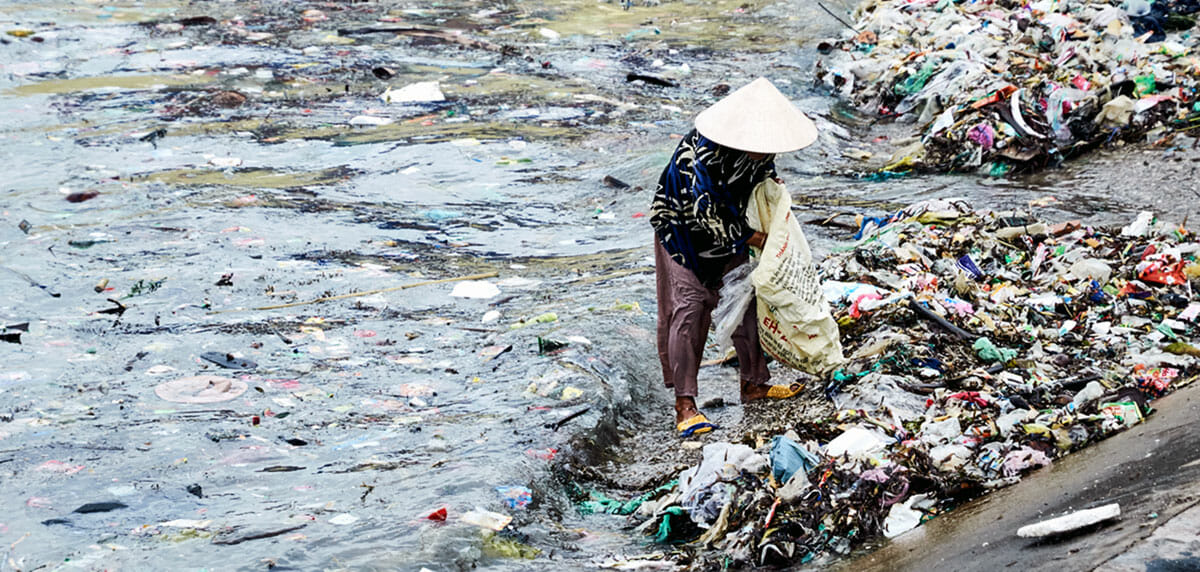
More than a half of the plastic waste in the oceans comes from five Asian countries. This is even though emerging and developing countries consume many times less plastic per capita than industrialized nations. The reason of these massive emissions lies in the predominantly inadequate waste management systems in the Global South. The POLYPROBLEM report of the Röchling Foundation and Wider Sense takes a close look at shortcomings and opportunities.
International comparative figures clearly show that plastic consumption increases with increasing prosperity. However, waste management in developing regions is not growing at the same pace. If this trend continues and this gap widens further, the world is only at the beginning of the plastic problem – despite the enormous public attention to the issue.
The non-profit Röchling Foundation and the consulting firm Wider Sense have comprehensively investigated in their POLYPROBLEM report entitled THE WASTE OF OTHERS why it has not yet been possible to establish a comprehensive waste management system as a basis for recycling and circular economy in emerging and developing countries.
The authors analyzed international studies and spoke with experts in development cooperation. They researched aid programs from large international organizations such as the World Bank or the United Nations and looked at activities of companies and their networks. They interviewed initiators of various projects from civil society and, last but not least, people affected on the ground.
“Our extensive research and analysis led to three central results,” summarize Michael Alberg-Seberich, Managing Director of Wider Sense, and Uwe Amrhein, Foundation Manager of Röchling Stiftung.
- The principle of Extended Producer Responsibility, which, among other things, ensures in the EU countries that the fillers of packaging participate in the financing of the infrastructure for collection, sorting and recycling, is not or only partially legally enshrined in many emerging and developing countries. There is an urgent need for action here.
- The introduction of extended producer responsibility and the associated waste management systems cannot simply be exported from the industrialized countries. For example, in India, the approximately 1.5 million private waste collectors currently collect far more plastic waste than the entire public system. In addition, there is the predominantly municipal responsibility with very different local conditions. Systems must therefore be developed that combine the principle of extended producer responsibility with the informal sector.
- Global support programs, measures of international development policy, corporate engagement and projects from civil society only come together in exceptional cases. “Of course, individual projects are funded by companies and the public sector. However, there is no large, multilateral offensive for the rapid and systematic dissemination of good solutions,” the editors critically note.
The POLYPROBLEM report is intended, among other things, to serve organizations, public institutions, companies and foundations that are involved in the field of plastics and the environment or are planning such involvement.
The POLYPROBLEM report “The Waste of Others” can be downloaded here.
Under the title POLYPROBLEM, the non-profit Röchling Foundation and Wider Sense are combining various information and networking offers that should contribute to better cooperation in solving this global challenge. These include studies, webinars, workshops and excursions.